Vertigo and dizziness in Guadalajara
Regain Your Stability and Walk Again Without Fear of Spinning
Dr. Karla Sanz evaluates the inner ear and vestibular system to resolve the physical cause of your vertigo, helping you recover your balance with clinically proven treatments.
What do you feel when walking or moving your head?
Balance system disorders manifest in various ways. Identifying your symptoms helps focus the diagnosis:
Sensation of Objects Spinning
You feel the room or things around you spinning violently, especially when lying down, getting up, or turning in bed.
Instability When Walking
Sensation of floating, walking on clouds, or losing direction, as if your body is not responding correctly to your steps.
Ringing & Clogged Ear
Vertigo accompanied by constant whistling (tinnitus), temporary hearing loss, or pressure inside the affected ear.
Nausea & Motion Intolerance
Cold sweats, upset stomach, and nausea triggered by simply moving your eyes or head.
Which specialist to visit? Otolaryngologist vs. Neurologist
The inner ear is the mechanical balance center (vestibular system). For this reason, Otolaryngology is the first line of assessment to diagnose peripheral vertigo (representing over 80% of cases), including Benign Paroxysmal Positional Vertigo (BPPV), Ménière's disease (which is often accompanied by ringing in the ear or tinnitus), and vestibular neuritis.
On the other hand, a Neurologist focuses on central vertigo, which originates in the brain or nervous system, such as vestibular migraine or brain circulatory issues. The subspecialty of Neurotology / Otoneurology manages complex, difficult-to-control cases of the inner ear or skull base.
Dr. Karla Sanz performs a comprehensive vestibular examination at her Guadalajara office to identify the origin of your symptoms. If she detects signs of central neurological origin during the office evaluation (atypical nystagmus, loss of strength or sensation), she will collaborate closely with a Neurology specialist for your timely referral and complete safety.

How much does a vertigo evaluation cost in Guadalajara?
Transparent, surprise-free pricing structure
Consulta de Valoración Especializada
Evaluación clínica integral de oído, nariz, garganta y vía respiratoria superior. Incluye tu historia clínica detallada, examen físico y la orientación del plan terapéutico inicial.
$1,000 MXN
The initial vestibular evaluation consultation is priced at $1,000 MXN. This appointment includes your detailed clinical history, physical examination for nystagmus (involuntary eye movements), and diagnostic maneuvers in the office (at Justo Sierra or Hospital Ángeles Andares).
BPPV Treatment: If a diagnosis of Benign Paroxysmal Positional Vertigo (loose crystals) is confirmed and clinically viable, physical repositioning maneuvers (such as Epley or Semont) will be performed during the same initial consultation at no extra cost. (Subsequent repositioning or rehabilitation sessions, if required, are quoted individually from $800 to $1,300 MXN).
Additional Diagnostic Studies: If clinical suspicion warrants technological studies to locate the lesion (such as videonystagmography or the vHIT test), the doctor will refer you to highly trusted imaging and testing centers in Guadalajara. These studies are quoted and paid for separately (local market average: $2,500 to $4,500 MXN) and are not included in the basic consultation.
Aviso de Consulta Presencial: El canal de WhatsApp es de carácter estrictamente administrativo para agendar y cotizar. Por ética médica y normatividad legal, no se realizan diagnósticos ni se prescriben tratamientos a distancia.
Steps of the office evaluation
Clinical History & Triage
We analyze the duration of your episodes (seconds vs. hours), triggers, ear symptoms, and your general medical history.
Vestibular Physical Examination
The doctor evaluates your eye reflexes in response to head movements and performs controlled positional maneuvers in the office.
Precision Diagnosis
We identify whether your case corresponds to BPPV, Ménière's, vestibular neuritis, or if it requires additional tests like vHIT or MRI.
Treatment / Action Plan
If it is BPPV, physical repositioning maneuvers are performed on the spot. If it has another cause, medical management or rehabilitation therapy is initiated.
Vestibular treatments and diagnostic options
Canalith Repositioning Maneuvers
Immediate mechanical treatment in the office for BPPV (such as Epley or Semont maneuvers). It consists of guided head movements to return the crystals (otoconia) to their original site in the inner ear, relieving vertigo without medication.
Videonystagmography (VNG)
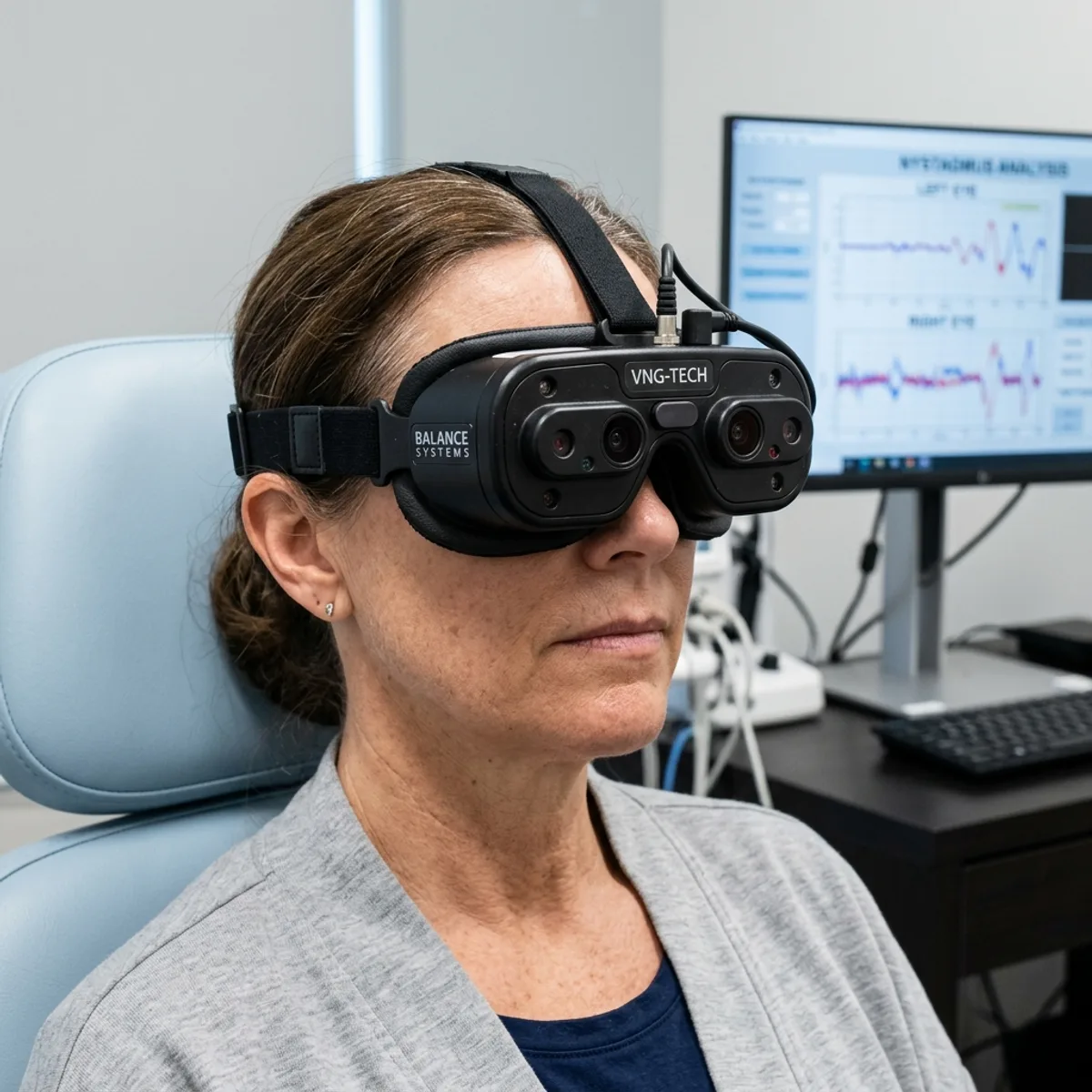
A diagnostic study that records involuntary eye movements (nystagmus) using special goggles equipped with infrared cameras. It allows precise determination of whether the balance problem originates in the ear or in the brain.
Video Head Impulse Test (vHIT)
A rapid, advanced technological evaluation that analyzes the vestibulo-ocular reflex using high-speed sensors. It is painless and individually evaluates each of the six semicircular canals in the inner ear.
Personalized Vestibular Rehabilitation
A brain retraining exercise program based on adaptation, habituation, and sensory substitution. Indicated for patients with persistent vestibular damage (such as aftermath of vestibular neuritis) to regain visual and body stability.
The care process for your recovery
Book an Appointment
Request your evaluation via WhatsApp, selecting the reason for your visit (dizziness when lying down, instability, or ringing in the ears).
Consultation & Examination
The doctor performs physical ocular, coordination, and balance tests to find the physical cause of your symptoms.
Maneuver or Treatment
If BPPV is diagnosed, physical repositioning maneuvers are performed during the same consultation to relocate the crystals.
Recovery Plan
We define whether you need preventive medical treatment, personalized vestibular rehabilitation, or referral for advanced studies.
Follow-up
We monitor your progress and the complete restoration of your balance to prevent relapses or falls.
Dra. Karla Sanz
Otorrinolaringóloga y Cirujana de Cabeza y Cuello
Médica cirujana egresada de la Universidad de Guadalajara, especialista certificada por el Certificada por el Consejo Mexicano de Otorrinolaringología y Cirugía de Cabeza y Cuello. Su práctica clínica y quirúrgica prioriza el diagnóstico responsable, combinando la salud y funcionalidad respiratoria con resultados estéticos naturales y equilibrados.
Frequently asked questions about vertigo and balance
Respuestas y aclaraciones sobre tu cirugía de nariz y valoración clínica.
Does vertigo have a definitive cure?
Can I perform the Epley maneuver myself by watching online videos?
Why doesn't diphenidol or cinnarizine cure my vertigo?
What is the difference between dizziness and vertigo?
What tests are needed to diagnose vertigo?
Última revisión y actualización de contenido: Junio 2026. Esta información tiene fines únicamente orientativos y no sustituye la valoración médica presencial.
When is dizziness or vertigo a neurological emergency?
If you or a family member experience vertigo or instability accompanied by any of the following symptoms, do not wait to schedule an office appointment. Go immediately to the nearest hospital emergency room:
- Sudden difficulty speaking, slurring words, or understanding speech.
- Weakness, numbness, or paralysis in the face, an arm, or a leg (especially on one side of the body).
- Double vision, blurred vision, or sudden loss of sight.
- Severe difficulty maintaining body balance, absolute inability to stand or walk.
- Extremely intense, sudden headache with no known cause.
- Loss of consciousness or recurrent fainting.
Ear, nose, or throat discomfort?
Schedule a consultation with Dr. Karla Sanz.